Ism number three – Futurism

Definition – Futurism

Futurism, in Italian Futurismo, in Russian Futurism, was an early twentieth-century artistic movement that was based mainly in Italy and emphasized the technology, speed, energy, and power of the machine and the vitality, change, and restlessness of modern life. It wasn’t just an artistic movement, it also influenced poetry. It was a backlash against the nineteenth century.

The movement was at its strongest from the year 1909, and diminished after 1918. It was in 1909 that Filippo Marinetti‘s first Futurism manifesto appeared. Futurism was a self-invented art movement. It also favoured the advancement of Fascism.

The Futurists loved to publish manifestos and they (usually led or prompted by Marinetti) wrote them on many topics, including painting, architecture, religion, clothing and cooking. Futurism had from the outset admired violence and was intensely patriotic.

Futurism was actually inspired by the growth of the Cubist movement but aimed to move beyond its techniques. The Futurists made rhythm with a repetition of lines. They broke up motion into small sequences, using a wide range of angles, within a given time frame. They wanted to incorporate the dimension of time within a painting. Lavish colours and flowing brush strokes added to the idea of movement.

Key Artists

Umberto Boccioni – Boccioni is arguably the most famous Italian Futurist. He trained from 1898 to 1902 in the studio of the painter Giacomo Ball, where he learned to paint in a Pointillist style. In 1907 he settled in Milan and became influenced by Marinetti. Boccioni  became a leading theoretician of Futurist art. He helped draw up and publish the Futurist Manifesto. This painting below is a perfect example of Futurist painting in its representation of dynamism, motion, and speed. The swirling human figures are repetitively fragmented complying with the Futurist style.

The City Rises

Giacomo Balla – Balla was another key artist who came to adopt the style of Futurism in his art, with an interest in depicting light, movement and speed. He was a major signatory to the Futurist Manifesto and began designing and painting Futurist furniture and also created Futurist ‘antineutral’ clothing. He also taught Umberto Boccioni.

Abstract Speed + Sound

Gino Severini – another Italian painter but also mosaicist, stage designer and writer. he was one of the principal exponents of Futurism, and he provided an important link between Italian and French art. He had quite a long career but his most significant works came before World War I.

El pam-pam de Monaco

Carlo Carra – Carra was another leading figure of the Futurist movement. He signed the Futurist manifesto along with Boccioni, Luigi Russolo and Marinetti. It was during his period as a Futurist that he produced some of his best known paintings.

Funeral of the Anarchist Galli

One Key Work

I found it hard to pick one key work so I chose one that seemed to represent many different elements of the Futurist movement, such as capturing movement, time, speed, dynamism, colour, and line, and that is Simultaneous Visions by Umberto Boccioni. This picture is so colouful and busy. It is almost science fiction.

Simultaneous Visions

References:

WebMuseum, Paris, http://www.ibiblio.org/wm/paint/glo/futurism/ [last accessed 12 November 2012]

Wikipedia on Futurism, http://en.wikipedia.org/wiki/Futurism [last accessed 12 November 2012]

Encyclopedia Brittanica on Boccioni, http://www.britannica.com/EBchecked/topic/70885/Umberto-Boccioni [last accessed 12 November 2012]

Wikipedia on Balla, http://en.wikipedia.org/wiki/Giacomo_Balla [last accessed 12 November 2012]

Matteson Art

Posted in Blog | Tagged , , , , , , | 3 Comments

Ism number two – Fauvism

Definition – Fauvism

Fauvism describes the style of the ‘les Fauves’ (which is French for ‘wild beasts’), a short-lived group of early twentieth-century French artists who aimed to emphaise painterly qualities in their art, and strong, bold colours over representational or realistic values.

The advent of Modernism is frequently dated to the appearance of the Fauves in Paris at the Salon d’Automne in 1905. Their style of painting, using non-naturalistic colours, has been described as one of the first avant-garde developments in European art. The Fauvists found their name when a critic pointed to a renaissance-like sculpture in the middle of that first exhibition and exclaimed with derision ‘Donatello au milieu des fauves!’ (‘Donatello among the wild beasts!’).

The style was basically expressionist, and distorted forms in landscapes featured the most.

The Fauvists believed absolutely in colour being an emotive force. Colour lost its descriptive qualities with the Fauvists and became luminous, creating light rather than imitating it.

Key Artists

Henri Matisse – Matisse felt he had to make colour serve his art. Matisse was recognized as a leader of the Fauves, along with André Derain; the two were friendly rivals, each with his own followers. He was known for his strong colours and talented draftsmanship.

Les toits de Collioure

André Derain – partner in crime in the Fauvist movement with Matisse. In March 1906, art dealer Amrbroise Vollard sent Derain to London to create a series of paintings focusing on the city. Deraine came up with 30 paintings that were radically different from anything done by previous painters. With bold colors and compositions, Derain painted multiple pictures of the Thames and Tower Bridge. These London paintings remain among his most popular work.

London Bridge

George Henri Rouault – Rouault exhibited several paintings along side the other Fauves in 1905. His sad and depressive impressions of judges, clowns, and prostitutes caused a big stir in Paris. The suffering of Christ was also a favourite subject.

Colourful Parisian life

Maurice de Vlaminck – Vlaminck shared a studio with Deraine and through him met Matisse. He began exhibiting with the pair in 1904 and took part in the famous 1905 exhibition which launched the trio as Fauvists. Although he had a long career in art he is best known for his period as a fellow Fauvist.

Potato Picker

One Key Work

The one key work I have chosen is Derain’s distinctly Fauvist portrait of Matisse, painted during the artists’ shared summer in Collioure. This painting provides a key example of the Fauvist tendency to experiment with a range of colors, apparently at random, and allowing the painter’s emotional state to dictate the composition. And also, with other well-known Fauvist portraiture, a detailed depiction of the subject was not of the utmost importance. Derain’s chief focus with this, and other portraits, landscapes, and stilllifes, was to express his mental state via a consistent use of broken brushstrokes and impulsive lines, both of which served to accentuate his applications of pure colour.

Henri Matisse

References:

Web Musuem, Paris, http://www.ibiblio.org/wm/paint/tl/20th/fauvism.html [last accessed 12 November 2012]
Wikipedia on Fauvism, http://en.wikipedia.org/wiki/Fauvism [last accessed 12 November 2012]

Wikipedia on Derain, http://en.wikipedia.org/wiki/Andr%C3%A9_Derain [last accessed 12 November 2012]

Shelley Esaak, About.com on Vlaminck, http://arthistory.about.com/od/namesvv/p/vlaminck.htm [last accessed 12 November 2012]

Posted in Blog | Leave a comment

Ism number one – Conceptualism

Definition – Conceptualism

In broad terms Conceptualism is the art of concepts or abstract ideas which take precedence over traditional aesthetic or material concerns.

Conceptualism began in the first half of the twentieth century. It began not as an art movement but as a philosophy. It is a questioning philosophy: questioning the meaning of art itself.  The work of Marcel Duchamp is fundamentally conceptualist. He argued that the idea of a work matters more than its physical representation.

As an artistic movement Conceptualism took form in the 1960s. It was a reaction against the contemporary art of that decade. Conceptualism is also about liberation. Any medium can be used to portray the artistic idea. It could even be the absence of a medium. Conceptual art is a rebellion against commercial art. Why should a poor work by a great artist be valued more than an outstanding work by a lesser artist?

Whilst some people find conceptual art refreshing and the only kind of art that is relevant to the contemporary world, many others consider it shocking, distasteful, lacking in real skill, ugly, and in fact not art at all. Conceptual art, it seems, is something that people either love or hate, either ‘get’ or do not ‘get’.

Key Artists

Marcel Duchamp – his Fountain of 1917 (mentioned in an earlier post) has been described as the birth of Conceptualism in art.

That urinal appears again

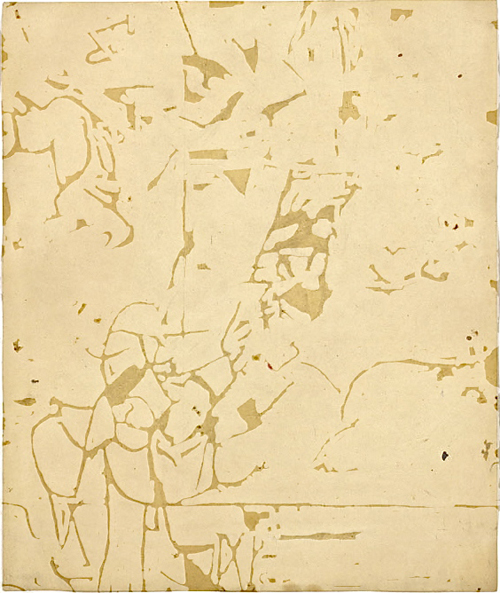
Robert Rauschenberg –  in 1953 he exhibited a piece called Erased De Kooning Drawing, a drawing by Willem De Kooning which Rauschenberg erased. This questioned the fundamental nature of art, challenging the viewer to consider whether erasing another artist’s work could be a creative act, as well as whether the work was only ‘art’ because the famous Rauschenberg had done it. In 1961 he sent a telegram to the Galerie Iris Clert which said: ‘This is a portrait of Iris Clert if I say so.’ This was his contribution to a portrait exhibition.

The erased drawing – is it art?

Joseph Kosuth – in 1965 he presented One and Three Chairs. The work consisted of a chair, its photo and a blow up of a definition of the word ‘chair’. Kosuth chose the definition from a dictionary. This is certainly ‘conceptual’.

Three Chairs

Tracey Emin – in 1999 she received a nomination for the Turner Prize. Part of her exhibit is My Bed, her dishevelled bed, surrounded by discarded objects such as condoms, blood-stained pants, bottles and her slippers. This is the ‘shocking’ side of Conceptualism.

Is Tracey’s bed art?

One Key Work

I think one of the most memorable key works of recent decades would be Damien Hirst’s 1991 The Physical Impossibility of Death in the Mind of Someone Living, a shark in formaldehyde in a vitrine. Of course there are many others I could have chosen. Conceptualism is alive and kicking.

He bites – watch out!

References:

Wikipedia, en.wikipedia.org/wiki/Conceptual_art [last accessed 12 November 2012]

Dostweb, http://www.art.dostweb.com/ [last accessed 12 November 2012]

Stanford University Encyclopedia of Philosophy, http://plato.stanford.edu/entries/conceptual-art/ [last accessed 12 November 2012]

Posted in Blog | Tagged , , , , , , | Leave a comment

I collect toilets

The BBC News website, that fountain of useful information, today informed me that the first ever toilet theme park is being opened in South Korea. So we have another mad collection on display, in honour of another mad collector.

The Restroom Cultural Park is, it seems, a unique collection of toilet-related art, sculpture, and other artifacts.

The theme park includes a toilet-shaped museum displaying Roman style loos, European bedpans, and old antique Korean flush toilets, as well as fun facts about human waste and a sculpture garden dedicated to squatting figures. The theme park is in Suwon and has been opened in memory to former mayor Sim Sim Jae-Duck, who was affectionately known as ‘Mr Toilet’. He spent his life campaigning to improve South Korea’s old-fashioned public toilets.

Statues doing poos?

Jae-Duck founded the World Toilet Association and unveiled his amazing toilet-shaped house just before the organization’s first General Assembly.

Who lives in a house like this?

Amazingly 19th November, just over a week from now, is World Toilet Day. It was created for a very good cause: to spread awareness of the over two billion people worldwide who do not have access to proper, clean sanitation. What will you be doing to celebrate World Toilet Day?

References:

BBC News website article, http://www.bbc.co.uk/news/world-asia-20258175 [last accessed 9 November 2012]


Posted in Blog | Tagged , | Leave a comment

Thoughts upon visiting a gallery

Life is quite chaotic for me at the moment: working freelance as many hours as I can, looking after three children, being an arty student, with no time to sit still. Yesterday I joined a college trip to the Walker Gallery in Liverpool and after a fretful four-hour journey (one that usually takes under two hours) partly spent catching up on work I was feeling quite fraught. Part of me was resenting my decision to take a day out of my regular working life to have a ‘jolly’ to Liverpool. I kept thinking about all the work I could have been doing and the fact I should have been at home with my children. And matters were made worse by the stress of enduring a terrible journey. But the moment I entered the gallery, all those thoughts and feelings dissipated completely and for the next two hours I became absorbed in the art and creativity around me. I was mesmerized by all that I saw. Each time I looked at a painting and felt a reaction I didn’t think it could be topped, yet it was, again and again. I didn’t think about anything else except the art, the meanings, the motivations, the effects on me and the calm I felt. What is it about galleries that bring about such a sense of peace and stability? I’m not an easily calmed person.

Perhaps it is because so much of art throughout history has been inspired by the religious experience? I don’t think it is that as I got the same reaction from modern art as I did from the Renaissance art (the latter more likely to depict images from religion and be inspired by religion).

Religion inspired art

Perhaps is it simply the fact that churches are places of amazing architecture, art, and beauty and that galleries are also places of amazing architecture, art and beauty. In that it is the ‘beautiful’ in art that evokes a spiritual experience just as the ‘beautiful’ in a church does. We are attracted by beauty but repelled by ugliness. Heaven and God is beauty and hell is ugly. I’m not sure it is simply that either.

A place of beauty, built on spirituality

Through the centuries, art has frequently been said to express the deep inner feelings, the desires of soul, that are central to a spiritual life. Is there such a thing as ‘spirituality of art’? In other words, the ways in which our aesthetic creations represent or symbolize the nature of our spiritual yearnings.

Harmony in Green made me feel harmonious

This made me wonder if perhaps it is to do with the artist’s motivation to create art. I think that the majority of art (and for that matter science) comes from some natural quest for an ultimate knowledge of reality. We all want to find an ultimate meaning of life, or any meaning in life, so can we conclude that a preoccupation of the artist (and the scientist) with this quest is firmly a spiritual quest, even if they don’t openly acknowledge such a quest? So this spiritual quest manifests itself in the end result on the canvas, and I pick up on that sense of spirituality by looking at the canvas. The end result: I felt calm and relaxed and fell asleep on the way home.

These people have been to an art gallery

I wonder…

Posted in Blog | Tagged | Leave a comment

Does eccentricity and creativity come hand in hand?

Researching artists who collect, artists who question collecting, and artists who obsessively collect made me wonder: are all artists a little bit, or a lot, eccentric? All of the artists I and my fellow art students researched were eccentric on some level, ranging from the slightly off centre to two miles over the edge.

Creative people do have a bit of a reputation for being eccentric, not just artists but writers also. For example Charles Dickens is said to have fended off imaginary urchins with his umbrella as he walked the streets of London. But it seems that eccentricity, or some degree of it, might be a prerequisite for having a creative disposition. Some might argue that eccentricity is a mild form of mental instability. I’m not so sure. I think you can be eccentric, yet perfectly of sound mind.

The internet tells me that both creativity and eccentricity may be the result of genetic variations that increase cognitive disinhibition. In other words, the brain’s failure to filter out extraneous information. So creativity and eccentricity are the result of bad genes it seems.

The internet also listed for me the ten most eccentric artists (this is someone else’s opinion, not my own, but worth stealing). These artists’ eccentricities can be summarized as follows:

1. Michelangelo. This very famous man was known for his many quirks and unique behaviours. He was bad tempered and earned himself a reputation for screaming at statues and slamming at their appendages in a variety of emotional states perhaps expecting a response. He also happily lived in poverty in spite of his financial successes.

Does he look like a raver of statues?

2. Leonardo da Vinci. This true Renaissance man wrote most of his notes backwards (he was left-handed, the best artists always are in my opinion). Some think he did this to hide the true meaning in his notes, others say he just preferred to do it that way (I subscribe to the latter opinion). He dressed in bright colors, short tunics, and man tights considered more appropriate for younger men. He also favoured long, flowing hair and a beard at a time when closely cropped, clean shaven looks were more in fashion.

Long beards are just not cool

3. Van Gogh. No need really to elaborate here.

4. Frida Kahlo. Using extreme physical and emotional traumas for inspiration, her paintings and life showed an obsession and preoccupation with pain and how it comes to physically and emotionally shape who we are. Kahlo suffered the traumas caused by her husband’s philandering behaviour, despite being as guilty as him of similar misdeeds.

This woman felt a lot of pain

5. Henry Darger. This guy spent most of his life collecting (yet another collector) bits of rubbish that he found of interest. None of his friends and family knew about his obsessions and artwork until after his death when his landlord discovered a stunning store of amazing literature and artwork.

Henry Darger’s art – undiscovered

6. Andy Warhol. Say no more.

7. Salvador Dali. The mustache says it all. Added to that Dali had a tendency to refer to himself in the third person.

Look into my eyes…

8. Daniel Johnston. Johnston attracted a number fans by giving out tapes to anyone and everyone he came across. His watercolors and sketches have an almost childlike quality to them, incorporating popular characters such as Captain America and Casper the Friendly Ghost. They reflect many of his almost childlike perspectives on the world.

9. Paul Gauguin. Gauguin harboured a strong obsession with cultures outside of his own, a hobby which remained fairly harmless, in fact it had a positive effect on his work. He fervently hoarded art and crafts from as far away as Japan, Tahiti, Martinique, Panama, Polynesia, and others as a means of inspiring what would later become highly influential work. Another collector it seems.

10. Pablo Picasso. And yet another famous collector, Picasso collected women.

Where’s my hat gone?

What do these ten people have in common, besides bad genes and peculiar quirks? Genuine creative people are constantly reinventing themselves. Anyone facing a difficult and challenging task is going to display some form of eccentricity. Artists need to analyse what they are doing that’s different from the norm, which includes collecting, testing, analysing, representing, teaching, displaying and looking. Surely uniqueness should be celebrated. So what making good art involves striping to your pants and dancing around the garden?

References:

Mark McGuiness ‘Why Creative People Need to be Eccentric’, 99U, http://99u.com/tips/7021/Why-Creative-People-Need-to-Be-Eccentric [last accessed 5 November 2012]

Shelley Carson, ‘The Unleashed Mind: Why Creative People Are Eccentric’, Scientific American, http://www.scientificamerican.com/article.cfm?id=the-unleashed-mind [last accessed 5 November 2012]

10 Most Eccentric Artists Ever to Live, Graphic Design Press, http://graphicdesigndegrees.org/10-most-eccentric-artists-ever-to-live/ [last accessed 5 November2012]

Posted in Blog | Tagged , , , , , , , , , , | Leave a comment

Other collectors worth a mention – from my fellow arty students

In today’s tutorial we discussed the various ‘collectors’ we had researched for homework and some interesting people and their take on collecting came up from my fellow students’ research, which I think is worth sharing here.

Laura Was and Adam Echstrom

Collaborative artists, Laura and Adam Echstrom, decided one day to collect lottery scratch cards. They were interested in how people spend their winnings after winning the lottery. They turned their research into amazing representational sculptures of desired material objects such as a Hummer, a yacht and a large luxury home using scratch-off lottery tickets.

Glitz and tat, or glamour?

The project was called Ghost of a Dream, and the aim was to match the monetary value of the lottery tickets to the price of each item. For example, they created a ‘Dream Home’ out of $70,000 worth of discarded tickets, the interior decor includes a chandelier, framed portraits, an ‘antique’ clock and vase of flowers. To the artists, the discarded lottery tickets represent unfulfilled dreams as well as money that could have been saved and possibly spent on the item itself. The objects have a glitzy crassness to them, perhaps representing the glitzy crassness of the objects they represent which are the material things lottery winnings can buy. On the other hand they have an aesthetic appeal, despite the glary colours.

Marcel Duchamp

Marcel Duchamp was a French artist whose work is most usually associated with Dadism and Surrealism. In his day he was regarded as quite shocking. Possibly he would be less so now, are we less shockable these days perhaps? That’s a future blog entry. Duchamp challenged conventional thought about artistic processes and art marketing in his collections and ideas about what constitutes a piece of artwork. Perhaps most famously with his urinal. He critised ‘retinal’ art, believing that anything could be art, it is the intention that is important, not necessarily the pure aesthetic value of the simple pleasure it brings. He came to a point in his career when he moved away from conventional art, disillusioned with two-dimensional art and the quest to create beauty in art. He famously created a porcelain urinal, which was signed ‘R.Mutt’ and titled Fountain. It was submitted for the exhibition of the Society of Independent Artists in 1917 but it was rejected by the committee, even though the rules stated that all works would be accepted from artists who paid the fee. This work is regarded by some art historians and theorists of the avant-garde as a significant landmark in modern art.

Is it art?

Paul Couillard

Paul Couillard is a Canadian performance artists who ‘collects’ performance art and works as a curator of performance art. He fits very neatly into the category of ‘art collector’ although not in a traditional sense. Performance art cannot be kept, except in recorded form, so to be a collector of performance art seems to be an impossibility. But to Couillard curating is a form of art in itself, it is a way of collecting and presenting, and a way of selecting particular pieces of art whether they be performances or otherwise. It is a form of bringing things together.

 Marina Abramovic

Marina Abramovic is another performance artist we talked about in our tutorial. Abromovic describes herself as the ‘grandmother of performance art’. Her work explores the relationship between performer and audience, the limits of the body, and the possibilities of the mind. She has collected other artists’ pieces of performance art and reinterpreted them in her own performance art. Some artists have rejected this as art, others have embraced it.

Staring at someone – performance art.

I was interested by the discussion we had about Abramovic and Couillard as I really don’t know much about performance art and had not heard of either of these two artists. Performance art is beyond my art radar being mostly a two-dimensional artist myself. I think it is an art form worth further musings.

Grayson Perry

The last artist we talked about was Turner-prize winning artist Grayson Perry, known for his cross-dressing and sexualized artwork. Grayson Perry spent some time as artist in residence at the British Museum and there he created the Tomb of the Unknown Craftsman exhibition. In the show he combined his own work with objects by mostly anonymous craftsmen that he has taken from the museum’s collection. He wanted to celebrate the craftsmanship of the unknown and the unacknowledged. He juxtaposed modern art next to ancient art. Objects he chose from the museum include drawings, prints, coins and religious objects. Perry’s decorated motorcycle, which has a stuffed toy on the back seat, also formed part of the display.

Fancy a ride?

All of the artists we talked about in the tutorial, which also included Portia Munson mentioned in another blog post and the three artists I researched seem to be rather on the eccentric side. Does eccentricity and art come hand in hand? Therein lies yet another future blog post.

References:

Cool Hunting, http://www.coolhunting.com/culture/the-art-of-disc.php [last accessed 5 November 2012]

Interview with Marina Abromovic, http://www.guardian.co.uk/artanddesign/2010/oct/03/interview-marina-abramovic-performance-artist [last accessed 5  November 2012]

Wikipedia on Paul Couillard, http://en.wikipedia.org/wiki/Paul_Couillard [last accessed 5 November 2012]

Grayson Perry at the British Museum review in the Telegraph

Posted in Blog | Tagged , , , , , | 1 Comment

More musings on drawing – do you have to use your hands?

Last night, on holiday on the edge of Wales, in a house with 13 children aged between two and eleven, I was half watching TV and half working on my contrast project when a news item being featured on Russell Howard’s Good News programme caught my ear (my eyes were on my work). It was about an student who after fearing having to drop A level art because of a painful joint condition taught herself to paint with her mouth instead. This got me thinking, once again, about what it means to ‘draw’ and what an artist can use to ‘draw’. It also made me ponder where artistic talent is, in the head or in the hand / mouth / foot?

Heather Purdham, a student from Essex, had been suffering from something called hypermobility syndrome. The condition meant that her joints were loose and it made holding a pen or brush both difficult and painful.

Heather was diagnosed with hypermobility syndrome the winter before her A levels finished but knew something was wrong as she struggled to do the amount of writing that was required of her at school. Inspired by the artist Alison Lapper, who was born without arms, Heather tried painting holding a brush in her mouth. It took her a while to get the hang of drawing with a different part of her body (she also tried using her toes) but eventually got used to it and she managed to get the highest mark you can get (that A* thing they didn’t have when I was at school) in her A level art exam.

The artist with her A level piece

I wonder if I could try the same thing? Of course I don’t have any reason to stop using my left hand to draw with, but wouldn’t it be interesting to see what sorts of marks I could make using my mouth? Would the result still have my own individual ‘style’ or would they be completely different? Would, in time, the drawings look very similar in style to the drawings I am able to create with my left hand? Given that it probably took me about ten years or so to develop the basics of my own particular drawing style with my left hand, would it take as long with the mouth? Or would having a ‘mouth’ style different from my ‘hand’ style be quite refreshing? Lots of questions, not many answers.

References:

BBC News Website, http://www.bbc.co.uk/news/uk-england-essex-19329641 [last accessed 2 November 2012]

Mouth and Foot Painting Artists, http://www.mfpausa.com/ [last accessed 2  November 2012]

Posted in Blog | Tagged , | Leave a comment

I can’t sleep! Is it because I am arty?

Insomnia and artistic expression have often been linked. Since starting my foundation course at college I’ve had more trouble sleeping than usual. I keep dreaming about my art, thinking about it, and lying awake trying to relax my mind with thoughts of art coming into my busy brain. So last night when I couldn’t sleep I started to wonder more about this topic (yes, I know, that’s hardly going to help me sleep). Google tells me that I’m not the only person to wonder this, a couple of years ago a major London gallery hosted a unique all-night investigation into the subject.

Artists throughout history have been known to suffer from an inability to sleep. The artist Louise Bourgeois suffered very badly from insomnia and created a range of drawings on the topic, including sketches of a clock ticking (all insomniacs are clock watchers) and an interpretation of the mad sleepless eye of an insomniac. Another artist, Tomoko Takahashi, is said to work through the night to create her amazing installations.

This eye does not sleep easily

The all-night session at the Serpentine Gallery in London, hosted along with the Victoria and Albert Museum, explored the relationship between sleeplessness and creativity. Participants were allowed to stay there for the night, during which they listened to lectures and watched films and experienced sleep-related performance art. Psychologists, artists and writers all took part to present a discussion about sleep disorders, dreams and art.

It has been said that when tired, the mind enters into an altered state of consciousness and is open up to new ideas. The Serpentine lectures, geared towards the insomniac, looked at the benefits of sleeplessness. Is it true that creativity flows in the midnight hours? Is this because the pressure and demands of daytime have ceased and the sleepless can delve into their imaginary world? As a recovering insomniac I can vouch that exhaustion can twist the mind and bring a whole new meaning to life, not necessarily a good one.

Or alternatively is it that creative types are simply more susceptible to sleep problems? The stereotypical sensitive and neurotic artist struggles to relax at any time, overwrought as he or she is by a troublesome mind. That certainly describes me at the moment.

The other night I dreamt a painting I just had to paint the following day, related to the Contrast task we have been given at college. It was such a vivid dream. I could picture it exactly and I was able to recreate it.

Is it genius or too much cheese before bedtime? My dream painting

This got me wondering also about the relationship between dreams and creativity as a step beyond insomnia and creativity. There is in fact a vast history of the famous finding inspiration in dreams. When you sleep your mind does not switch off; in fact the opposite occurs and it becomes very active while dreaming. Through dreams, the mind continues to think through solutions to real life and work issues and it uses its innate creativity and problem solving skills to do so. How often have you woken up at 3am and thought ‘Eureka!’? The artist Jasper Johns painted his first American flag after seeing it in a dream. Doctor Jekyll and Mr Hyde and Frankenstein appeared to their creators first in dreams. Stephen King it is said dreamt the plot to Misery on an areoplane ride. Paul McCartney claimed that he dreamt the tune to Yesterday one night. The German physiologist Otto Loewi won the Nobel Prize for medicine after he dreamed about how to prove his theory regarding the chemical transmission of nerve impulses. How fab is that? What are you waiting for? Go to bed!

Does this guy have miserable dreams?

References:

Brilliant Dreams, http://www.brilliantdreams.com/product/famous-dreams.htm [last accessed 23 October 2012]

Hannah Duguid, ‘Insomnia: Sleepless at the Serpentine’, The Independent (28 July 2010), http://www.independent.co.uk/arts-entertainment/art/features/insomnia-sleepless-at-the-serpentine-2036775.html [last accessed 23 October 2012]

Serpentine Gallery, http://www.serpentinegallery.org/2010/07/park_nightssleep_overfriday_30.html [last accessed 23 October 2012]

Posted in Blog | Tagged , , , | Leave a comment

Three artists – another artist who has worked with institutional collecting

In late 2010 The Natural History Museum invited a contemporary Chinese artist to be its first international artist-in-residence for the Images of Nature gallery.

The artist was called Hu Yun, and he comes from Shanghai. He stayed with the museum for three months in September-December 2010. His residency was related to the scientific illustration collection, especially the John Reeves collection. Yun was selected to work with and research the Reeves collection during his time at the museum. He was asked to create a one-off commissioned work based on his time there.

Drawing by one of the Chinese artisans in the John Reeves collection

John Reeves came to China in the early 19th century and during his stay in China he commissioned many native Chinese artisans to create scientific illustrations of Chinese plants and animals. The drawings had a certain ‘Chinese’ style to them even though the artisans had been instructed by Reeves to reproduce each specimen in a particular way. Yun responded to these drawings as a contemporary artist. He saw the illustrations as artwork rather than scientific illustrations. Yun used these illustrations, and any experiences he had while working at the museum, to inspire his own work. So the drawings from the 19th century which he examined found their way into his own artwork. Yun was particularly interested in the fact that many of the artisans who created the amazing and intricate drawings are unknown. He decided to make a memorial to the unknown artists, who’s nicknames only had beenlisted by Reeves.

The memorial Yun created

References:

The Natural History Museum, http://www.nhm.ac.uk/nature-online/art-nature-imaging/collections/reeves/modern-response/index.html [last accessed 23 October 2012]

Gasworks, http://www.gasworks.org.uk/residencies/detail.php?id=577 [last accessed 22 October 2012]


Posted in Blog | Tagged , | Leave a comment